Coverage published on November 24, 2026, described a Commodity Futures Trading Commission staff advisory from the day before: regulated derivatives exchanges, trading platforms and clearinghouses may count Bitcoin, Ether and certain payment stablecoins toward the financial resources they must hold for operating costs, but only after set discounts, and not as cash for a separate liquidity test.
In a November 23, 2026 announcement, the CFTC said its Division of Market Oversight and Division of Clearing and Risk had outlined how registered entities could use crypto holdings to meet existing financial-resource requirements, if they apply discounts for potential risks. The advisory covers swap execution facilities (SEFs), designated contract markets (DCMs) and derivatives clearing organizations (DCOs). Those firms must maintain financial resources sufficient to cover at least 12 months of operating costs.
The guidance followed questions from several registered firms and applicants that already hold digital assets and wanted to know whether those holdings could count. Rules already set how much derivatives firms must set aside for operations, but they had not explicitly addressed Bitcoin, Ether and payment stablecoins for that purpose.
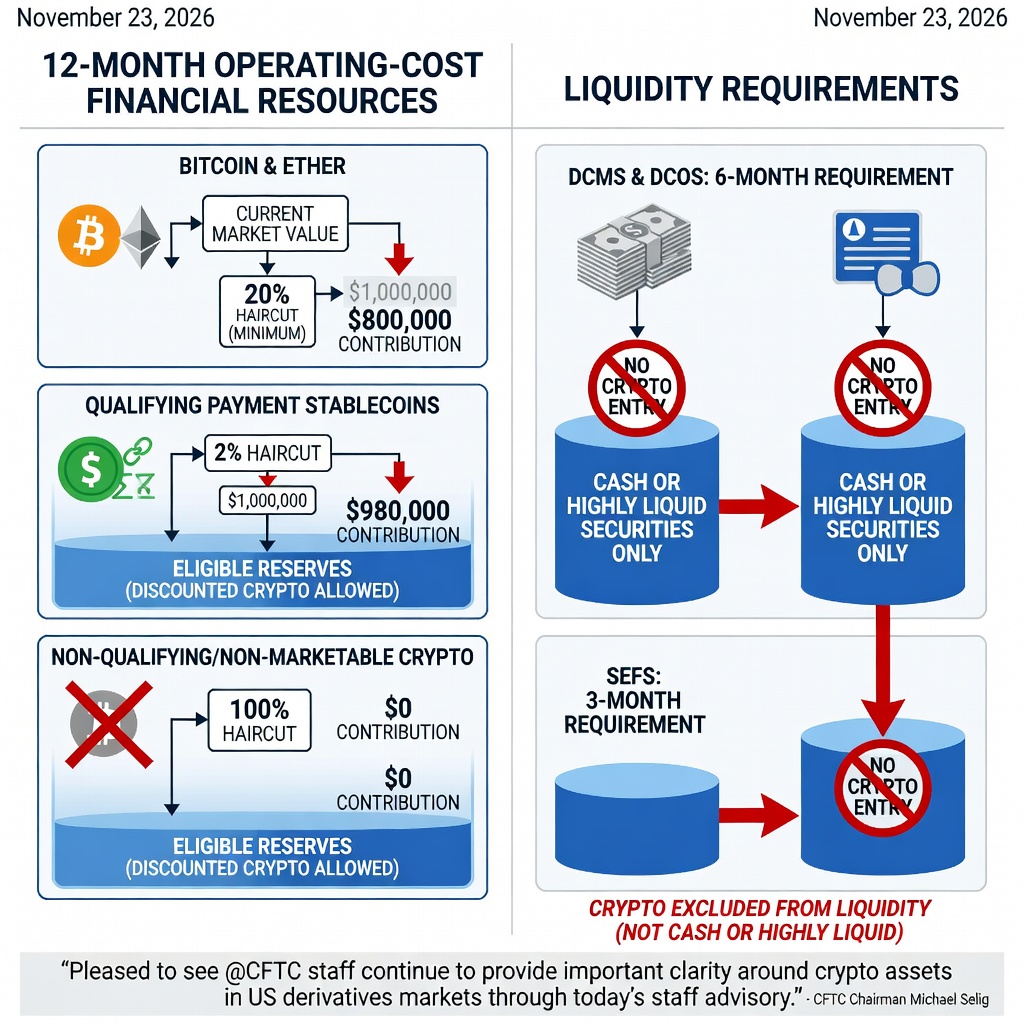
Staff said firms must start from current market value, then apply a haircut for market and credit risk. They would not object to a minimum haircut of 20% for Bitcoin and Ether and 2% for qualifying payment stablecoins, consistent with the treatment of proprietary crypto holdings under existing regulatory-capital guidance for futures commission merchants.
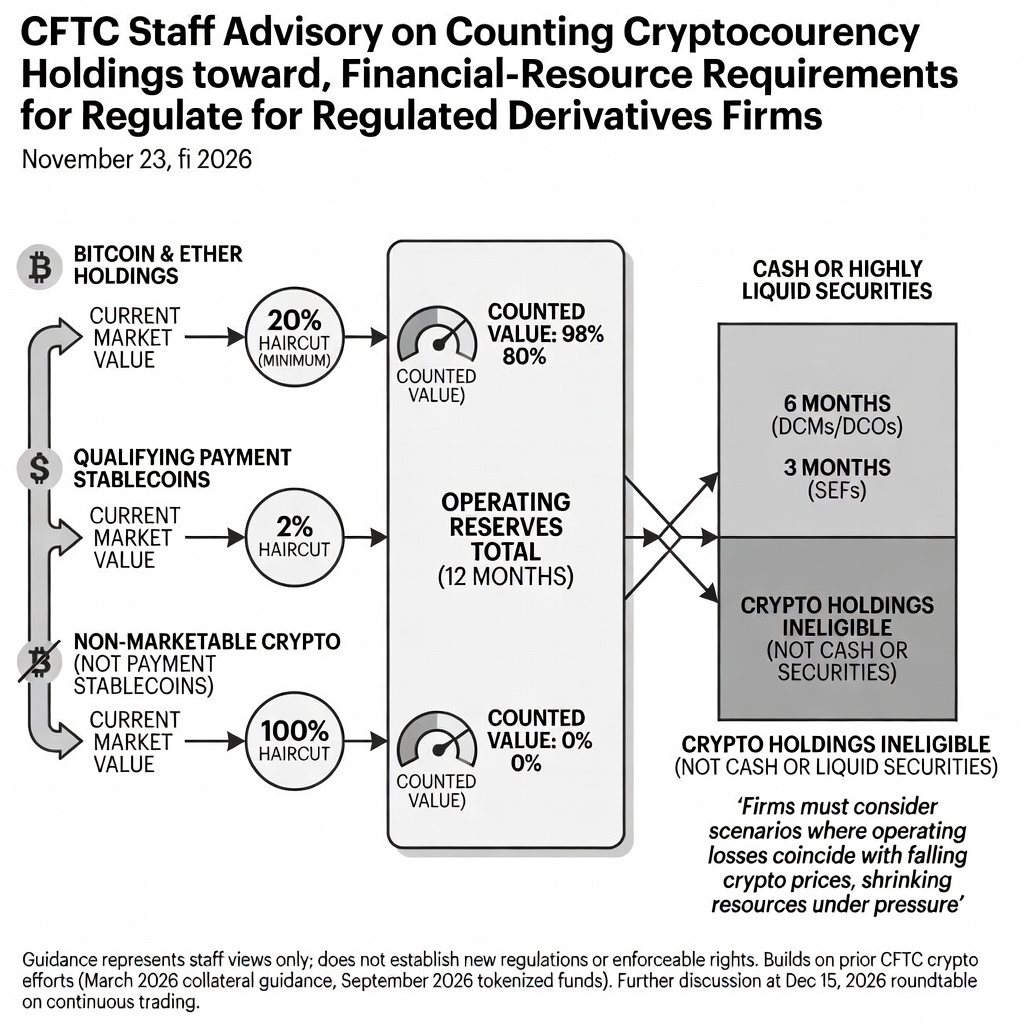
On that basis, a derivatives exchange holding $1 million of Bitcoin could count $800,000 toward its financial-resources requirement after a 20% haircut. The same market value in qualifying payment stablecoins could contribute $980,000 after a 2% deduction. Crypto that is not readily marketable and does not qualify as a payment stablecoin would generally receive a 100% haircut, which leaves it out of the calculation. Firms looking at digital assets beyond Bitcoin, Ether and payment stablecoins were told to consult the relevant CFTC divisions about their obligations.
The liquidity rules were left as they were. DCMs and DCOs must still keep cash or highly liquid securities sufficient to cover at least six months of operating expenses. SEFs have a separate three-month liquidity requirement. The CFTC said cryptocurrencies, including payment stablecoins, do not qualify as “cash” or “highly liquid securities” under the applicable accounting and regulatory framework. A trading exchange with $12 million in annual operating costs would still need eligible liquid assets covering at least $6 million, regardless of the value of its Bitcoin or Ether.
The advisory also recommends that firms consider cases in which operating losses coincide with falling cryptocurrency prices, so resources shrink while the business is under pressure. The commission said the guidance represents staff views and does not establish new regulations or legally enforceable rights.
CFTC Chairman Michael Selig welcomed the advisory in a post on X the same day, describing it as another step in clarifying how digital assets are treated in regulated U.S. derivatives markets. “Pleased to see @CFTC staff continue to provide important clarity around crypto assets in US derivatives markets through today’s staff advisory,” he wrote.
The November advisory was presented as part of a longer sequence of CFTC work on crypto in derivatives markets. As previously reported in March 2026, the agency had issued guidance on crypto collateral, including when clearinghouses could accept Bitcoin, Ether and stablecoins as initial margin. In September 2026, it updated guidance on tokenized customer-fund investments, including the use of blockchain technology for regulatory records. Further discussion was scheduled for a December 15, 2026 roundtable on continuous trading, where participants were to examine how stablecoins, tokenized collateral and blockchain technology could support clearing and margin management outside traditional banking hours.
Separately, on November 23, 2026, the CFTC published a final rule—not a staff advisory—establishing a data-reporting framework for certain fully collateralized event contracts. The rule sets reporting obligations for qualifying contracts, including those traded through regulated prediction markets, and puts a permanent framework in place for that data reporting.