
An illustration in the Ethereum Foundation’s Mandate became the focus of a dispute over whether staff could challenge leadership without risking their jobs. In an account published on November 11, 2026, GridPlus CEO Justin Leroux examined a lawsuit filed by former Foundation protocol support lead Kayleen Fulton, known in the Ethereum community as Nixo. The complaint presents Fulton’s account of events; at the time of Leroux’s writing, the Foundation had not filed a response.
From a cultural reference to a staff objection
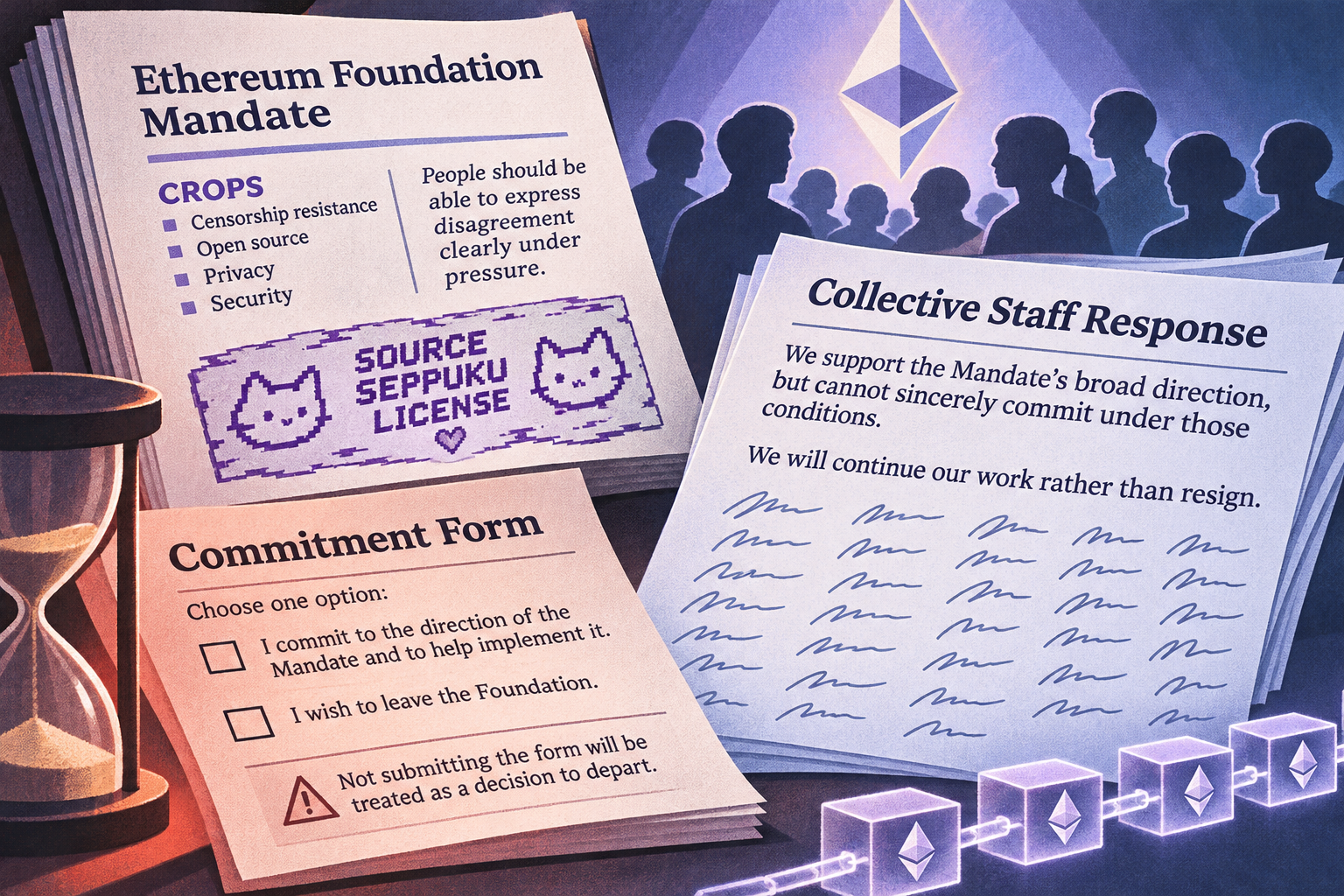
The Foundation published the Mandate on March 13, 2026. It set out principles including censorship resistance, open source, privacy and security—collectively called CROPS. It also said people should be able to express disagreement clearly under pressure.
The document contained a small illustration of the “Source Seppuku License,” a reference drawn from Milady NFT culture that uses language about suicide if commitments are broken. Leroux described it as a joke, but reported that employees objected after receiving a draft. According to his account, 79 staff members voted for its removal. The Foundation retained the text in the published document, which it then wrote to the Ethereum blockchain. Leroux argued that keeping the reference after those objections mattered more than whether it was intended literally.
A commitment form and a collective reply
According to the complaint as described by Leroux, co-executive director Bastian Aue told staff on March 20 that the time for raising concerns about the Mandate had passed. Employees were then asked to submit a form committing to its direction or indicating that they wished to leave; not submitting the form would be treated as a decision to depart. After an employee asked whether signing carried a literal obligation related to the illustration, the form was amended to say it did not.
On March 25, Fulton publicly sent a collective response coordinated with Trent Van Epps. Its signatories said they supported the Mandate’s broad direction but could not sincerely commit under those conditions. They said they would continue their work rather than resign. The letter initially had 49 signatures and eventually 53—about half the protocol group, according to Leroux. On March 27, Aue said he would treat their signatures as objections to the process while recognizing their commitment to the Mandate’s content. He also said he would handle many aspects differently if given another chance.
What the lawsuit alleges happened next
On April 6, Aue dismissed Van Epps and Fulton, the two organizers, according to the complaint. Leroux reported that Fulton had informed leadership 13 days earlier that she had been diagnosed with cancer, was beginning treatment and wanted to maintain her employment. The complaint’s account of the dismissals and their circumstances remains the plaintiff’s allegation, not a court finding.
Leroux also described Vitalik Buterin as defending the decision to retain the illustration and the abrupt introduction of the commitment requirement. He noted that co-executive director and board member Hsiao-Wei Wang had called Fulton’s concerns vital to the Foundation’s future.
For Leroux, the central question is whether the Foundation applied its stated principles when employees disagreed with it. He called on its board to acknowledge that the ultimatum and dismissals were wrong, remove the disputed illustration and make room for open dissent. Those are his proposed remedies, not changes the Foundation had announced.