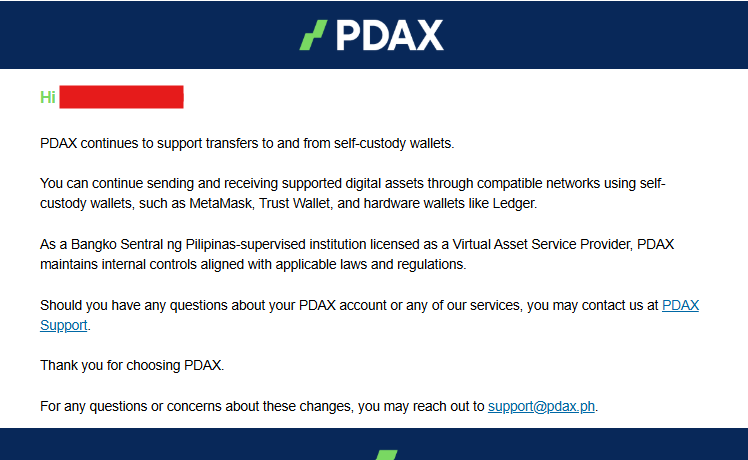
In an email to customers reported on November 28, 2026, Philippine Digital Asset Exchange (PDAX) confirmed that users can still move supported crypto assets between the exchange and wallets they control themselves. The policy covers deposits and withdrawals on compatible blockchain networks, including transfers involving software wallets such as MetaMask and Trust Wallet or hardware wallets such as Ledger.
The distinction matters for users of two licensed Philippine exchanges. On November 19, Coins.ph stopped direct transfers to and from self-custody wallets. It now limits external crypto deposits and withdrawals to accounts at other regulated exchanges and requires Travel Rule disclosures for every transfer.
In a November 24 statement, Coins.ph described its restriction as a “risk-based” implementation of Travel Rule standards set by the Bangko Sentral ng Pilipinas (BSP). BSP Circular No. 1108 and Memorandum No. M-2023-042 require licensed virtual asset service providers to conduct sanctions screening and enhanced due diligence on unhosted wallets. The decision to stop direct transfers was Coins.ph’s. PDAX, also a BSP-supervised provider, said its internal controls align with applicable Philippine laws and regulations and that it continues to allow those transfers.
How PDAX users paid for retail bonds
During the Bureau of the Treasury’s November 19–24 offering of Retail Dollar Bonds Tranche 3, roughly 1,200 local retail investors used stablecoins on PDAX to buy about $1 million in three-year Philippine government bonds. Their subscriptions averaged $750 per investor, above the $200 minimum. The bonds carry a 5.65% annual coupon, and the offering raised approximately $1.3 billion across all distribution channels.
Investors paid with stablecoins including USD Coin, Tether, Western Union’s USDPT and Ripple’s RLUSD. The bonds themselves were conventional securities: PDAX Securities Inc., the exchange’s licensed broker-dealer subsidiary, converted the stablecoins into U.S. dollars before settling the orders in the Treasury’s National Registry of Scripless Securities.