
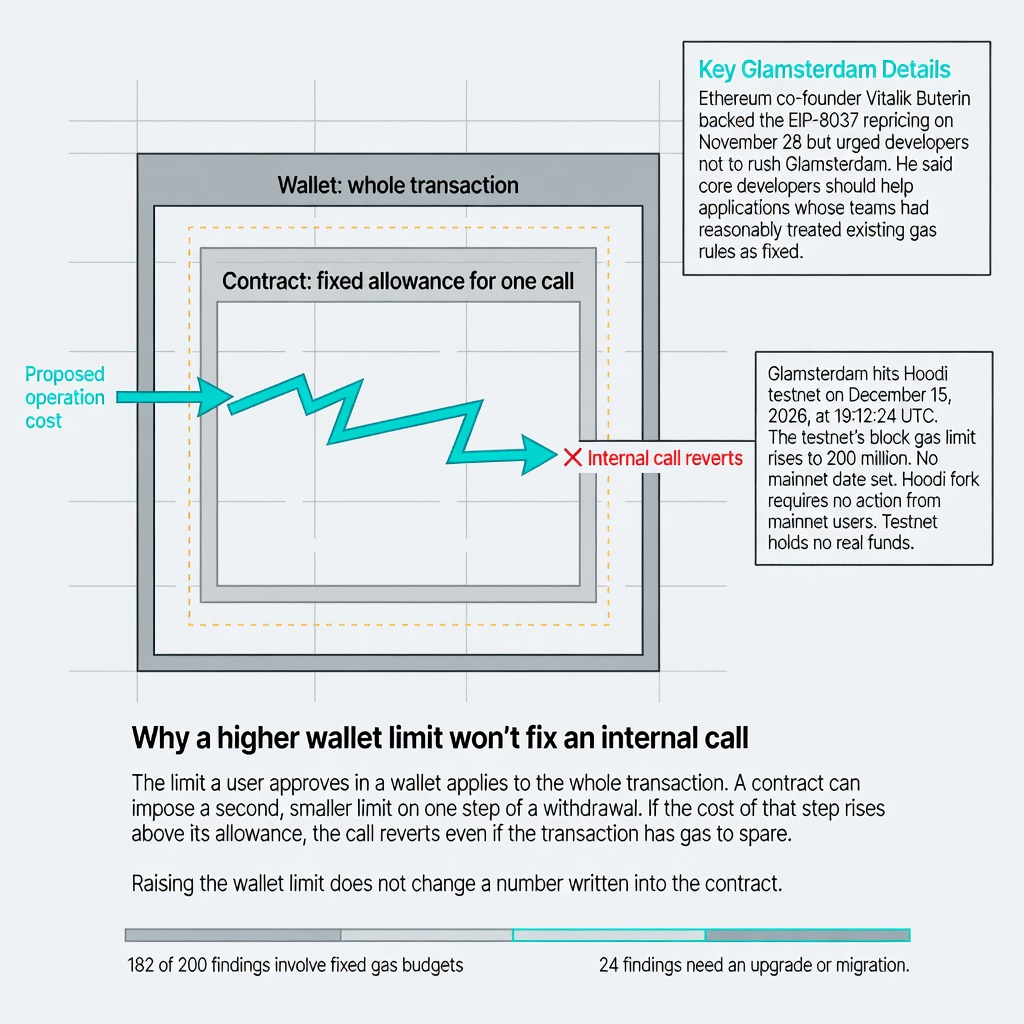
A withdrawal can fail even when a user has allowed plenty of gas in their wallet. That distinction is at the heart of Ethereum’s planned Glamsterdam upgrade: of 200 findings in a review of how deployed contracts would handle the proposed gas prices, 182 involved contracts that give an internal call a fixed gas budget.
Ethereum developers have scheduled Glamsterdam for the Hoodi testnet on December 15, 2026, at 19:12:24 UTC. The testnet’s block gas limit is set to rise to 200 million at the same time. As of November 29, Ethereum had set no mainnet date, and the Hoodi fork requires no action from mainnet users. The testnet holds no real funds.
Ethereum co-founder Vitalik Buterin backed the EIP-8037 repricing on November 28 but urged developers not to rush Glamsterdam. He said core developers should help applications whose teams had reasonably treated existing gas rules as fixed.
Why a higher wallet limit won’t fix an internal call
The limit a user approves in a wallet applies to the whole transaction. A contract can impose a second, smaller limit on one step of a withdrawal. If the cost of that step rises above its allowance, the call reverts even if the transaction has gas to spare. Raising the wallet limit does not change a number written into the contract.
Fixed budgets are one of eight assumptions flagged in Ethereum Foundation guidance. For example, a contract might calculate what a user owes by taking two readings of remaining gas with gasleft() and subtracting one from the other. Under the proposed rules, remaining gas can rise during a call, making that calculation unreliable. A contract that reserves gas for a later storage write could also come up short. The authors of EIP-8037 say ERC-4337 bundlers, which process smart-wallet transactions, are among the systems that could assign the new costs incorrectly.

What would cost more, and why
EIP-8037 proposes a uniform charge of 1,530 gas for each byte added to Ethereum’s state: the balances, contract code and storage that full nodes keep. Under existing rules, adding the same amount of data can cost different amounts depending on how it is created. EIP-8038 addresses the cost of working with data that already exists.
| Operation | Proposed change in gas cost | Proposal |
|---|---|---|
| Create a storage slot | 20,000 to 97,920 | EIP-8037 |
| Create an account | 25,000 to 183,600 | EIP-8037 |
| Deploy a full 24 kB contract | About 4.9 million to 37.8 million | EIP-8037 |
| Update an existing storage slot | About 7,200 more per write | EIP-8038 |
| Access an account for the first time in a transaction | 2,600 to 3,000 | EIP-8038 |
| Read a storage slot for the first time | Unchanged at 2,100 | EIP-8038 |
The EIP-8037 authors point to what happened when the block gas limit rose from 30 million to 60 million: daily additions to state roughly tripled. Geth’s state database was about 390 GiB in January 2026. At a 200 million gas limit with existing prices, the authors project about 387 GiB of new state per year, enough to cross a 650 GiB performance threshold in under a year. Their target with repricing is 120 GiB of annual growth.
What the review found
The Ethereum Foundation commissioned ChainSecurity and Dedaub to examine deployed contracts and conducted its own investigations. In its November 18 assessment, ChainSecurity combined AI-assisted code review with a year of mainnet transaction traces, then replayed suspected cases under both sets of gas rules.
Including the Foundation’s work, the assessment recorded three high-severity findings, 30 medium and 167 low, with none critical. Those are findings, not 200 distinct apps: one system can account for several. The public summary named no individual apps. It listed bridges, messaging systems, wallets, exchanges, governance systems, oracles, staking protocols and supporting off-chain services. ChainSecurity cautioned that a system’s absence from the results does not establish that it is unaffected.
According to ChainSecurity, most findings can be resolved without new code, while 24 require a contract upgrade or migration. The difference matters to users:
- Configuration change: If the contract exposes a gas setting, its operator can raise the allowance without asking users to do anything.
- Contract upgrade: A team or governance vote can replace the logic of an upgradeable contract while keeping its address. Users may see an upgrade notice or governance proposal.
- Migration: If the old code cannot be changed, the team deploys a replacement. Existing positions remain in the old contract until users move them according to the team’s official instructions.
What Hoodi can and cannot show
Developers postponed Hoodi’s original October 26 fork to study the effect on deployed contracts. On November 6, the Foundation said the fork would wait until those issues were resolved; by November 9, it had received four reports of live contracts that could break. It scheduled a November 16 call for auditors to present findings and a November 19 call on next steps. Developers retained the specification and merged the Hoodi configuration for December 15.
If Hoodi continues finalizing blocks after the switch, that will show that the client software agrees on the new rules at the higher gas limit. It will not establish that a particular bridge can complete a withdrawal or a staking contract can pay out. For that, the app’s team needs to replay those operations on Hoodi and publish the results.
Wallet software has a separate task before any mainnet activation. EIP-8038 notes that wallets using standard gas estimation need the new formulas; otherwise, they may underestimate gas and submit transactions that fail. Once wallets and node providers update, the usual signing process stays the same. Developers checking their own contracts can use the Foundation’s list of gas assumptions and report suspected issues to [email protected].