
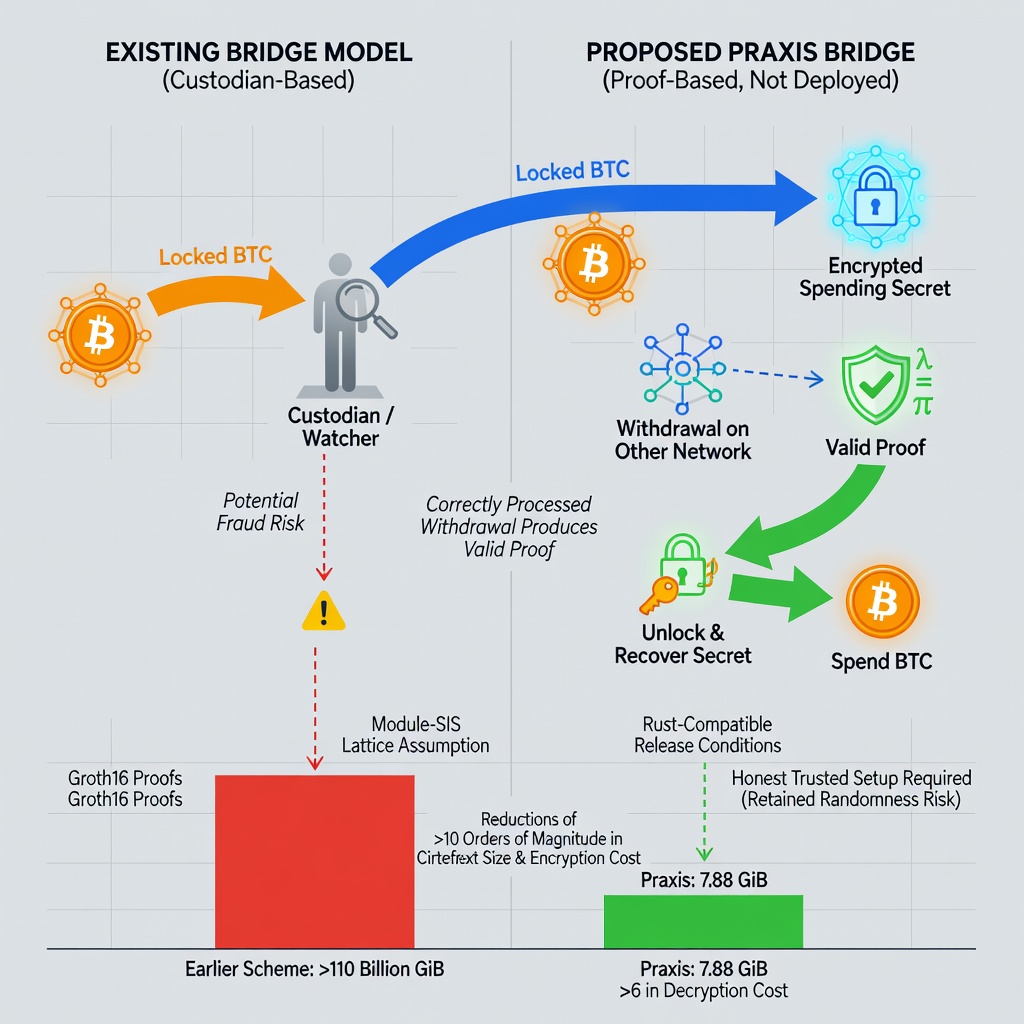
Originally reported on November 24, 2026, Praxis is a cryptographic scheme that could change who a Bitcoin bridge user needs to trust. Researchers from Stanford University and Byzantine Research describe how a bridge could encrypt the secret needed to spend locked BTC so that anyone with valid proof of a correctly processed withdrawal on another network could recover it. The bridge is a proposed use of Praxis, not a deployed system.
A proof instead of a custodian
Bitcoin’s scripting language makes it difficult to verify complex computations performed on another blockchain. BitVM takes an optimistic approach: computations run off Bitcoin, and participants can challenge false claims through transactions on the main network. Citrea, a Bitcoin zero-knowledge rollup that launched its mainnet in January 2026, uses a BitVM-based mechanism that needs at least one honest participant to challenge fraud.
In Praxis: Practical Witness Encryption for NP, David Tse, Nikhil Vanjani and Psi Vesely describe a different approach. Witness encryption, introduced in 2013, ties decryption to a mathematical statement. As the authors put it, “A ciphertext carries its own release condition, with no key to distribute and no party trusted to release the message.”
For a bridge, that distinction matters: rather than relying on a custodian to release funds or a watcher to spot a false withdrawal, the protocol could require proof before the spending secret becomes available. Its security would still depend on how precisely the bridge defines and enforces a valid withdrawal. The authors also identify Bitcoin covenants, which restrict how coins may subsequently be spent, as a potential application.
What changed in the storage calculation
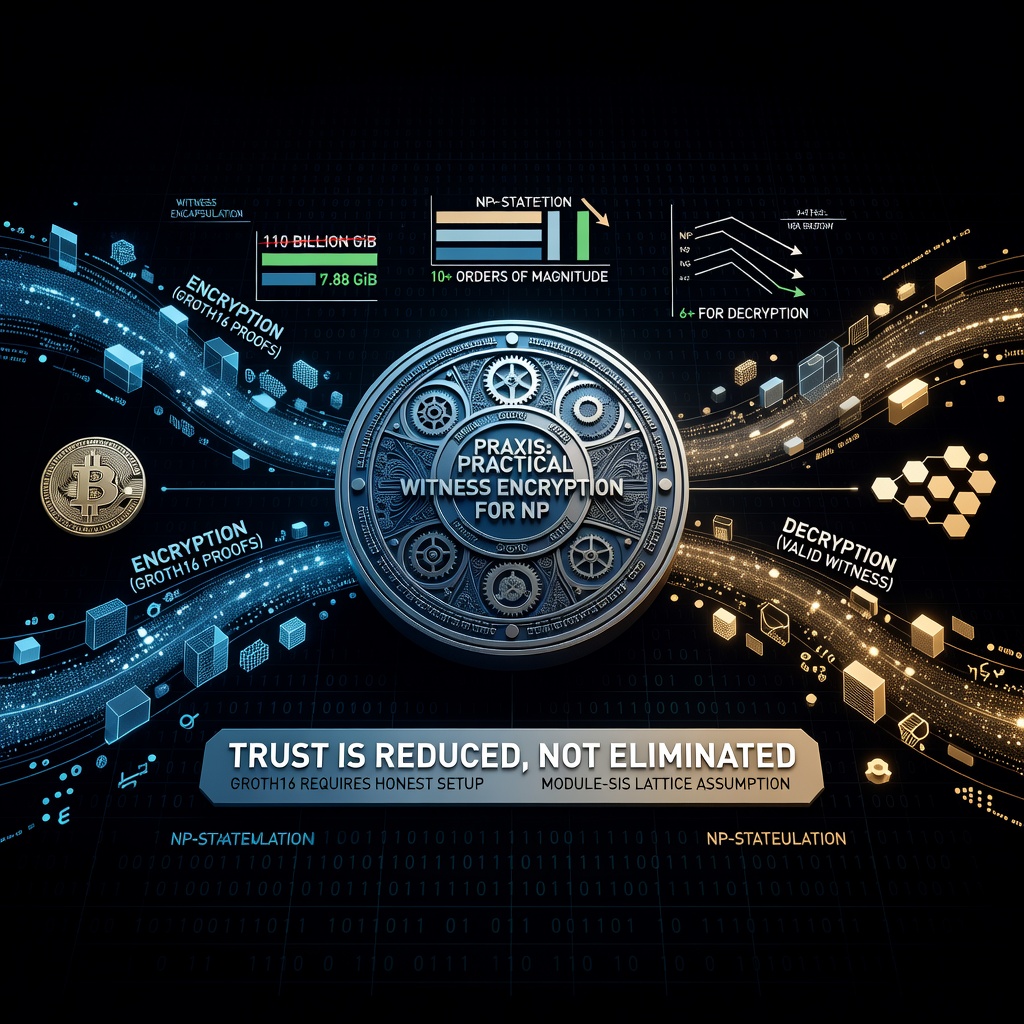
The researchers compared Praxis with an earlier construction by cryptographers Hair and Sahai. At a 100-bit security level, they calculated that encrypting a 100-bit key against the same statement would require more than 110 billion GiB of ciphertext with the earlier scheme, versus 7.88 GiB with Praxis. They report reductions of more than ten orders of magnitude in ciphertext size and encryption cost, and more than six in decryption cost.
Praxis generates a secret key that can encrypt messages of any length using conventional symmetric encryption. A person with a valid witness must find one unknown mathematical value to recover the key; without the witness, the problem involves four unknowns. The security argument relies on a lattice-based assumption called Module-SIS. The authors describe Praxis as the first general-purpose construction to combine security guarantees under specified assumptions with costs they consider practical.
The construction uses Groth16 proofs and a single verification key across different programs. A developer could express a release condition in a language such as Rust, provided a compatible proof system can verify the program’s execution. The paper says encryption and decryption can each take seconds on a laptop, requiring about 12 GB and 5 GB of memory, respectively.
Trust is reduced, not eliminated. The proposed Groth16 implementation requires an honest setup: anyone who retains the setup’s secret randomness could decrypt ciphertexts created with the corresponding verification key.
Why Bitcoin developers have been watching ciphertext size
A separate proposal illustrates the storage problem. In February 2026, Alloc Init founder Misha Komarov said the second iteration of a witness encryption construction called PIPEs required roughly 330 TB of ciphertext storage. Researchers had identified a possible route to approximately 100 GB, not an achieved reduction.
In September 2026, Alloc Init researchers introduced Shielded Bitcoin, a proposed system intended to conceal transaction participants and amounts without changing Bitcoin’s consensus rules. It proposes to use PIPEs for deposits and withdrawals; it is not an implementation of Praxis.