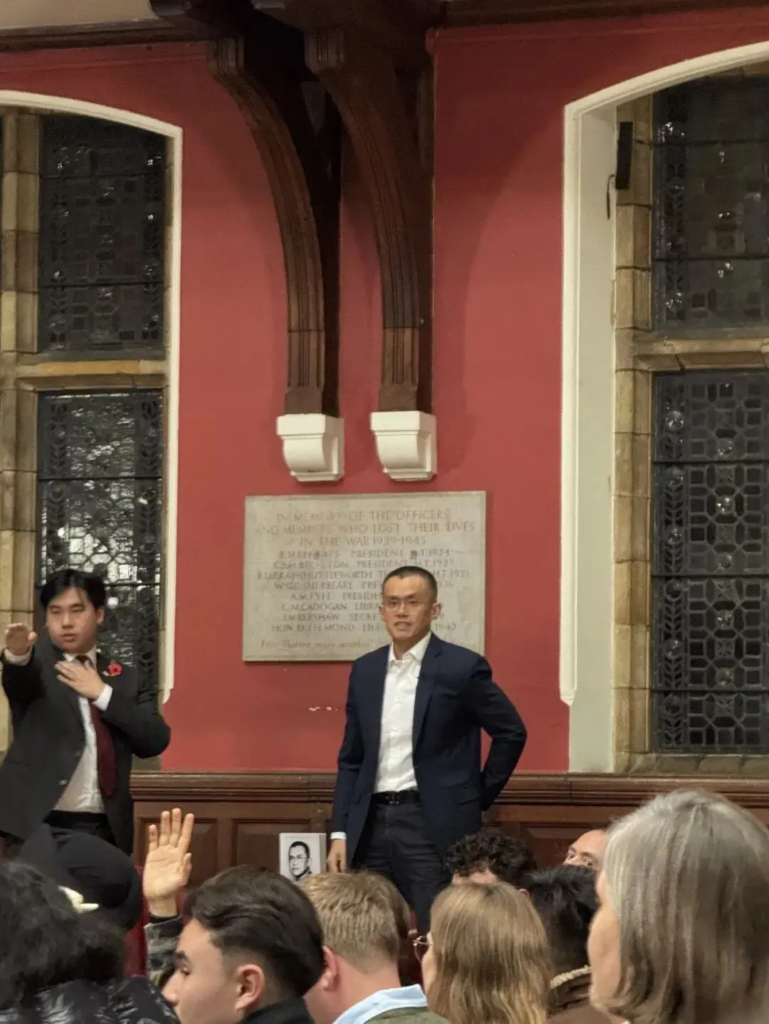
On November 3, 2026, Changpeng “CZ” Zhao appeared before a packed Oxford Union hall for a discussion framed around his book Freedom of Money. The most pressing question was not about the book. After a major Binance security incident, the moderator asked why users should still trust the platform.
In an investigation update issued that day, Binance said the incident involved approximately $6.34 billion in digital assets. It said roughly $2.85 billion in related assets had been frozen or intercepted as of that update, and that it had allocated enough funds to cover losses while gradually replenishing affected assets. Those figures describe assets involved and the response reported by Binance; they should not be read as an independently verified $6.34 billion loss.
The account of the Oxford conversation was published on November 6, 2026. It describes a discussion lasting nearly an hour, including 19 questions from the room. For a founder closely identified with Binance, the exchange put a familiar crypto question in unusually direct terms: what can a platform point to when users are asked to trust it after a failure?
Responsibility without a guarantee
Zhao acknowledged shortcomings in Binance’s security and operations. He said the sophistication of an attack would not excuse failures for which the platform was responsible, while emphasizing its communication after the incident and its commitment to absorb users’ asset losses. He declined to promise that an attack could never happen again.
In Zhao’s account, the attackers may have spent around five or six months preparing, using approaches including fake recruitment and social engineering before applying AI to understand systems more quickly. He also said some basic operational security procedures at Binance had not been followed strictly. These details are his account of the attack, not independently established findings in the Oxford discussion.
Zhao described drawing on Binance’s SAFU user-protection fund, insurance funds and company money to make users whole. He put SAFU at roughly the billion-dollar scale, but some funding details were estimates given onstage rather than audited figures. A question from the audience pressed the distinction between trusting Zhao personally and trusting Binance. No longer its CEO, he argued that protection of user assets must be a platform principle that survives any founder’s tenure.
The wider argument—and its limits
Zhao connected Oxford Union’s tradition of free expression to the “freedom of money” theme of his book. He also spoke of a possible “freedom of intelligence” enabled by technology. That is his vision for the industry, not an answer to whether Binance’s safeguards will work.
Asked why cryptocurrency remains useful, he pointed to difficulties with bank access and cross-border payments in some places, inflation and the potential for around-the-clock transactions. He also acknowledged unresolved questions around fees, compliance, custody and consumer protection; the potential of the technology does not mean every crypto service has proved better than a bank.
AI ran through both sides of his account. Zhao said he uses natural-language AI coding tools and expects AI agents to create demand for small machine-to-machine payments. He also warned that attackers can use AI to become more effective. On stablecoins, central bank digital currencies and Bitcoin, he presented them as tools for different purposes rather than interchangeable answers. Discussing Hong Kong, he cautioned against treating signs of support for financial innovation as a signal of comprehensive opening.
The Oxford appearance did not establish that the incident’s losses had been fully resolved or that another breach could be ruled out. It did make the gap between a founder’s public assurances and a platform’s demonstrable practices the central issue of the evening.