
Binance’s account of a reported roughly $6.34 billion theft became a debate about operational security as much as the attackers themselves. As reported on November 4, 2026, reactions split between those who saw preventable failures at the platform and those who emphasized the difficulty of stopping a sophisticated intrusion.
According to Binance’s review, the attack chain stretched across roughly four to five months. In June, a wallet-operations engineer searching for an AI coding tool downloaded a tampered Homebrew installer. In September, another engineer encountered a fake interview invitation on a recruitment platform and downloaded an “assignment” file despite endpoint protections. Binance said the attackers later used an internal AI tool to move through its systems, obtained a container-deployment token and reached the wallet-signing service.
SlowMist founder Yu Xian argued that the incident should be understood as an advanced persistent threat, not reduced to an engineer’s mistake or excessive permissions. In his view, an attack of this kind can combine reconnaissance, social engineering, malicious code that evades detection, abuse of trusted systems and cloud infiltration. He said the initial social engineering was only one part of the chain.
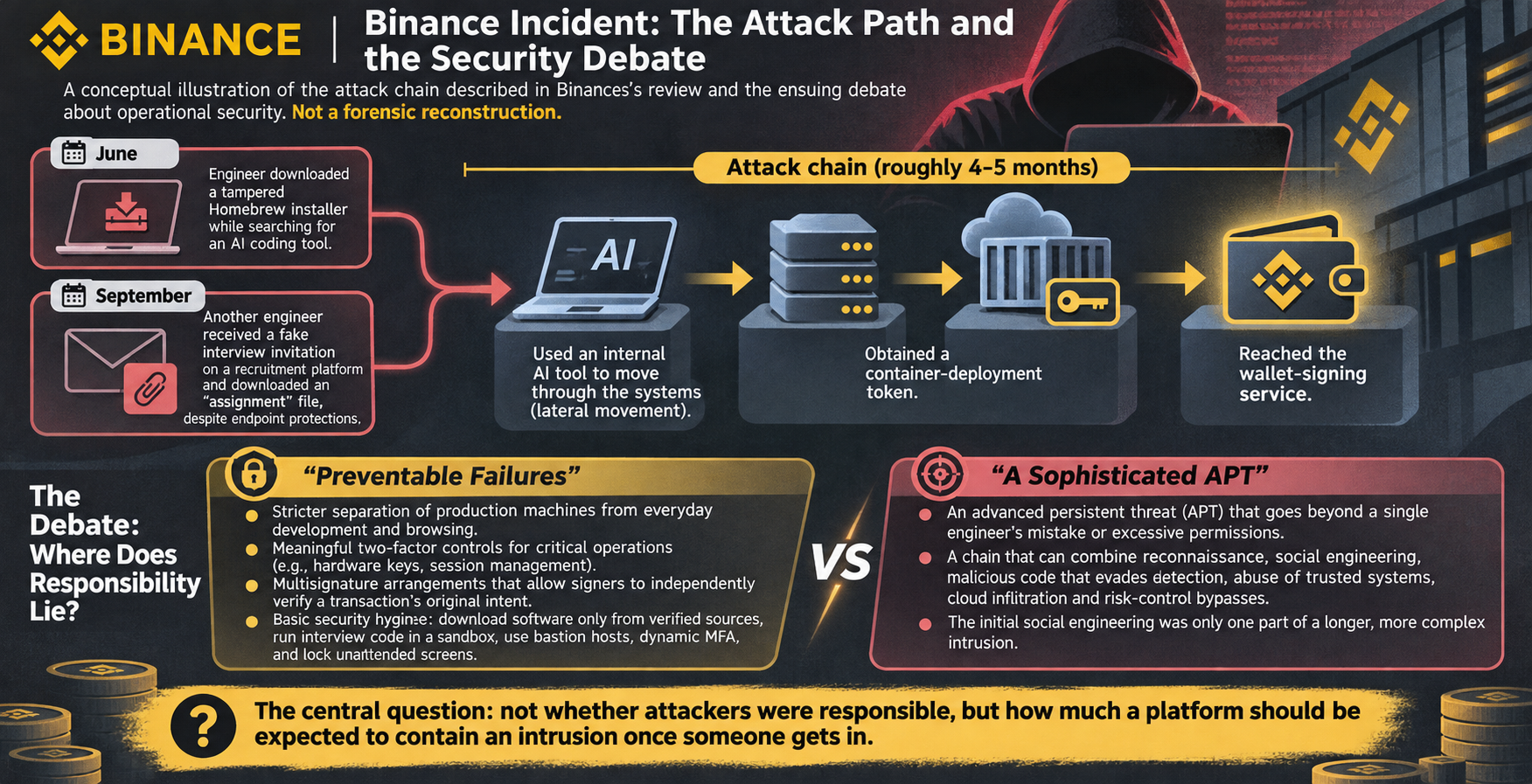
Others focused on barriers they believed should have held. CoinEx founder Yang Haipo criticized what he described as inadequate separation of production machines from everyday development and browsing, insufficiently meaningful two-factor controls for critical operations, and multisignature arrangements in which signers might not independently verify a transaction’s original intent. Security auditor pashov likewise argued for downloading software only from verified official sources and running any interview code in a sandbox—not on a work machine with production access. Investor blanker said basic measures such as bastion hosts, dynamic multifactor authentication and locking unattended screens should be standard.
OKX CEO Star questioned whether Binance’s claimed layers of defense worked in practice. Star argued that Binance’s emphasis on “only 2%” of funds leaving did not answer security concerns, and questioned its marketing for new deposits during the crisis. Telaga Charity founder ashen also challenged the apparent device and permission controls, arguing that an infected computer should not be able to put a multibillion-dollar hot wallet at risk.
Former PayPal president David Marcus characterized the incident as an operational-security failure rather than a failure of cryptography or the blockchain. Dragonfly partner Haseeb Qureshi argued that crypto infrastructure should assume a breach will happen and have round-the-clock AI monitoring and an effective emergency shutdown mechanism ready. Across the disagreement, the central question was not whether attackers were responsible, but how much a platform should be expected to contain an intrusion once someone gets in.