
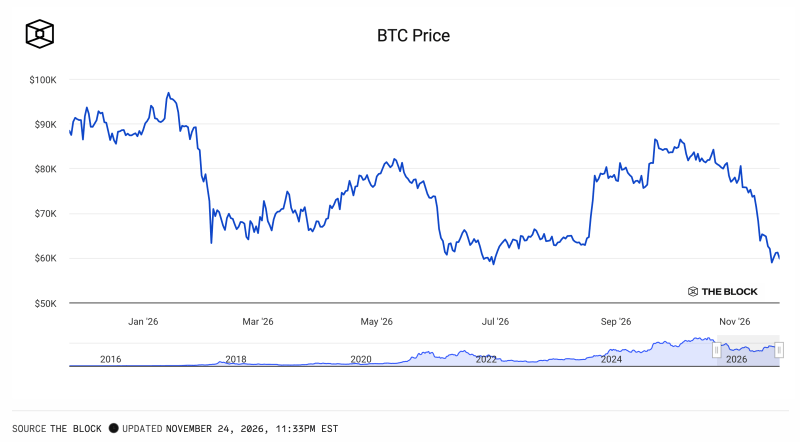
Galaxy withdrew its October assessment that bitcoin’s bear market had ended in June. In a November 25, 2026, research note, Alex Thorn, Galaxy’s head of firmwide research, said the firm would treat a daily close below $58,525, the June 30 closing low, as the start of a move toward a substantially lower low.
The distinction between an intraday price and a closing price mattered on November 25, 2026. Bitcoin fell to about $57,300 during the day but traded at $60,677 by 10:50 p.m. ET, up 2.4% over 24 hours, according to The Block’s price data. Ether rose 2.1% to $1,695, BNB gained 3.2% and XRP added 4.2%.
Why Galaxy changed its view
Thorn’s October assessment rested on bitcoin’s September recovery above its 50-week moving average, a level that had historically acted as a ceiling during bear markets. Bitcoin closed above it for seven consecutive weeks, then closed below it in early November. It later closed below the 200-week average as well.
Thorn said bitcoin had until about December 8 to regain the average, but he considered a timely recovery unlikely. Galaxy identified seven prior bear markets in which bitcoin broke a comparable closing low. In each, the price subsequently fell at least another 17%. That figure describes those earlier episodes, not a forecast for this one.
Alongside the $58,525 daily closing level, Thorn identified $59,517 as the June low on a weekly closing basis. He said a weekly close back above the 200-week average, followed by one above the 50-week average, would move Galaxy closer to its October view.
Rates, equities and bitcoin fund holdings
Galaxy also pointed to a weaker economic backdrop. On November 19, the two-year U.S. Treasury yield stood 0.88 percentage point above the federal funds rate, which Thorn interpreted as a sign that markets expected a higher policy rate. The S&P 500, just 1.5% below its record at bitcoin’s June low, closed 11.6% below its record on November 20.
According to Galaxy, U.S. spot bitcoin exchange-traded products shed 71,339 BTC ($4.95 billion) from October 4, with outflows in 22 of 35 trading sessions. Galaxy estimated that the products held 1.24 million BTC, 9.7% below their October 9, 2025, peak.
Thorn said it was unclear whether Jensen Huang’s November 23 return to Nvidia could lift bitcoin enough to end the bear market. Galaxy was also watching whether financial advisers increased their holdings of bitcoin exchange-traded products and whether the two-year Treasury yield moved back toward the federal funds rate.